The 2026 Refrigerant Shift: What Whittier Homeowners Need to Know
April 7, 2026
By Varitek Heating & Air Conditioning Team
For decades, homeowners from the historic streets of Uptown Whittier to the sprawling estates of Friendly Hills have relied on a cooling standard that is quietly disappearing. As of April 2026, the HVAC industry is undergoing its most significant transformation in a generation. With California’s strict new environmental mandates now in full effect, many local residents are finding themselves at a crossroads between expensive repairs and the new era of high-efficiency technology.
Recent data shows a surge in very specific local inquiries. Neighbors are frequently heading to Google to ask: “Is R-410A being banned in California?”, “What is the cost of an R-410A recharge in 2026?”, and “New R-454B vs. R-32 systems.”To understand why these searches are trending, one must look at the “Great Refrigerant Transition” through the eyes of an experienced technician who has spent years navigating the attics and crawlspaces of the Gateway Cities.
The Evolution of Cooling: The Science of “GWP”
The industry isn’t changing just for the sake of change; it is evolving toward a future where home comfort and environmental stewardship go hand-in-hand. The primary driver behind this shift is a metric called Global Warming Potential (GWP). Every refrigerant is assigned a number based on how much heat it traps in the atmosphere if it were to leak.
-
R-410A has a GWP of approximately 2,088.
-
The new 2026 standards require refrigerants to have a GWP of 750 or lower.
By switching to gases like R-454B (GWP of 466) or R-32 (GWP of 675), the industry is effectively reducing the environmental “footprint” of a single AC unit by over 70%. This transition ensures that the natural beauty of the Whittier Narrows and the hiking trails of Turnbull Canyon are protected for the next generation of Californians.
The Regulatory Engine: The AIM Act vs. Title 24
Homeowners often ask if these changes are just a California thing. The answer is both yes and no. It is a partnership between federal law and state enforcement.
-
The AIM Act (Federal Law): This is the national mandate passed by Congress. It requires an 85% reduction in the production of HFC refrigerants (like R-410A) by 2036. This is the reason R-410A is becoming scarce and more expensive across the entire country (Read More on the AIM Act).
-
The “15-Pound Rule” of 2026: A major update under the AIM Act that went into effect on January 1, 2026, is the lowering of the leak repair threshold. Previously, only very large commercial systems were under federal “leak repair” oversight. Now, the EPA has lowered that threshold to 15 pounds. While most standard Whittier homes have units with 6–10 pounds of gas, larger homes or multi-zone systems often cross that 15-pound line, meaning they are now subject to strict federal leak-tracking and mandatory repair timelines.
-
California’s Title 24 (State Code): If the AIM Act is the engine, Title 24 is the steering wheel. California uses its energy code to implement these federal goals even faster. This is why our local building standards for 2026 require these new, low-GWP systems for almost all new installations and major alterations.
The End of the R-410A Era
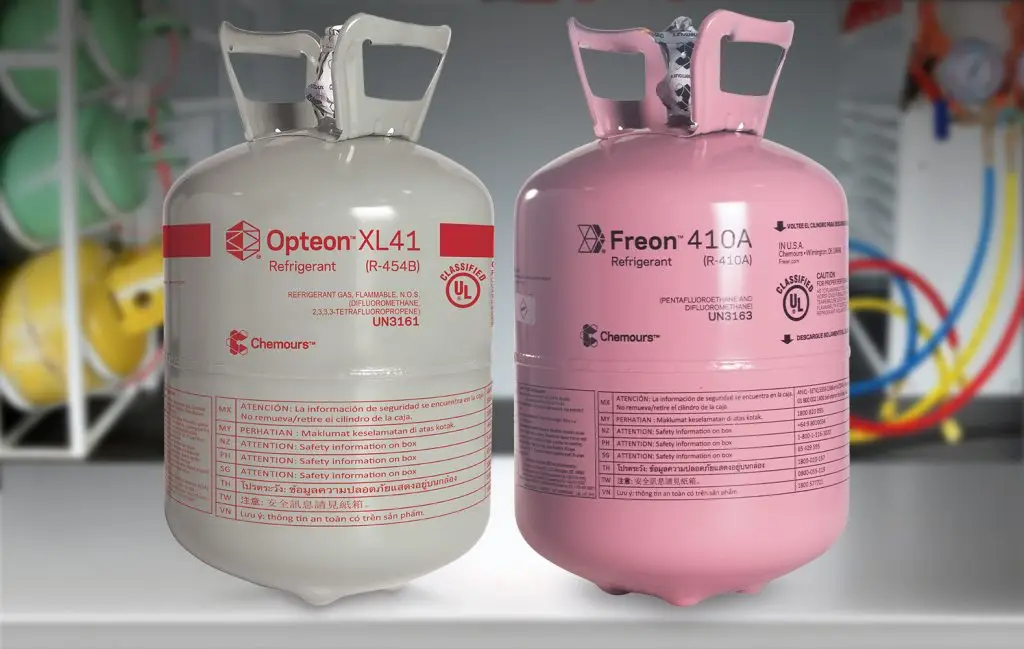
Since the mid-2000s, almost every air conditioner installed near Whittier College or along Whittier Blvd utilized a refrigerant known as R-410A (often called Puron). It was efficient and reliable for its time, but as part of the California 2025/2026 Energy Code (Title 24), the production of new R-410A systems has officially ceased.
While it is perfectly legal to continue operating an existing R-410A unit, the supply of the gas itself is being phased down. This has created a “supply and demand” challenge for homeowners with older units. In 2026, a standard “recharge”—the process of adding refrigerant back into a leaking system—has become a major technical and financial decision. As the phase-down continues, the availability of R-410A decreases, which naturally increases service costs. For many, this is the “tipping point” where a repair no longer makes long-term sense compared to an upgrade.
Understanding the New Standards: R-32 and R-454B
For those looking at new installations, the terminology has shifted. Homeowners are no longer choosing just a brand; they are navigating the difference between two primary new refrigerants:
-
R-32: Known for its high efficiency and excellent heat transfer, this is a single-component refrigerant that has been used successfully across Europe and Asia for years.
-
R-454B: This is a blend specifically designed to meet the lowest possible GWP requirements. Many major American manufacturers have adopted this as their primary choice for the 2026 rollout.
From a technical perspective, both are excellent choices for the Whittier climate. Whether a home is facing the dry heat near Pio Pico State Historic Park or the humid afternoons near the Whittier Narrows, these new systems are designed to provide superior dehumidification and help manage energy consumption.
The “A2L” Safety Question
A common concern appearing in local forums involves the safety of these new “A2L” refrigerants. Some sources use the term “mildly flammable,” which can cause unnecessary alarm.
Experienced technicians are quick to point out that these systems are incredibly safe. The new 2026 models are equipped with advanced sensors and safety mitigation boards that were non-existent in older units. In the rare event of a leak, the system automatically shuts down and engages the blower to dilute the concentration of the gas. Statistically, the standard natural gas lines running to a kitchen stove near Michigan Park pose a significantly higher risk than a modern AC unit.
The Whittier Dilemma: Repair or Replace?
Deciding whether to patch up an old system or invest in a 2026-compliant unit is the most frequent conversation happening at kitchen tables across the city.
-
The Case for Repair: If a system is relatively new and the issue is mechanical—such as a failed capacitor, a worn-out contactor, or a faulty fan motor—a repair is almost always the right move. These parts remain readily available and do not require handling expensive refrigerants.
-
The Case for Replacement: If a unit is over 12 years old and develops a refrigerant leak, the math changes. Investing in a major repair for a system nearing the end of its life is often described by technicians as “throwing good money after bad.” Furthermore, 2026 Federal Tax Credits for high-efficiency heat pump installations can make the transition to new technology more accessible.
Local Maintenance: The Best Defense
The unique geography of Whittier—nestled between the 605 freeway and the hills—means that local HVAC units are prone to heavy dust and debris buildup. Technicians often find that “refrigerant leaks” are actually the result of high-pressure stress caused by dirty outdoor coils.
Homeowners can often avoid the “recharge” conversation entirely by performing simple maintenance. Keeping the area around the outdoor unit clear of foliage and gently hosing down the coils can extend the life of an R-410A system by several years, delaying the need for a costly transition.
A Positive Outlook for Whittier’s Future
This shift offers a “win-win” for the local environment and the homeowner’s wallet. Because these new refrigerants are more efficient at carrying heat, the systems don’t have to work as hard to cool a home during a triple-digit Whittier July.
-
Higher Energy Efficiency: The thermodynamic properties of R-32 and R-454B allow for smaller, more efficient equipment. This means less electricity pulled from the grid and lower monthly bills.
-
Reduced Resource Consumption: Many 2026 systems actually require a smaller total charge of refrigerant than older models. We are quite literally “doing more with less.”
For Whittier homeowners, this means that while the name of the gas in the copper lines might be different, the peace of mind—and the chill in the air—has never been better.
Navigating the 2026 Transition with Varitek
While the industry terminology—SEER2, GWP, A2L, and Title 24—can be overwhelming, the goal remains the same: a cool, comfortable home.
Varitek Heating & Air Conditioning has been a fixture in the Whittier community since 2003. As a family-owned and operated business, their technicians specialize in helping neighbors navigate these new regulations without high-pressure sales tactics. They understand that every home, from the bungalows near The Quad to the modern builds in Murphy Ranch, requires a customized approach.
With the 2026 cooling season fast approaching, now is the time to evaluate the health of your home’s HVAC system. Varitek is currently offering specialized seasonal tune-ups through our Varitek Comfort Plan. This service is specifically designed to catch small issues before they become expensive refrigerant leaks.
Contact Varitek Heating & Air Conditioning today to schedule a professional efficiency audit and ensure your home stays comfortable, compliant, and cost-effective for years to come.