
December 4, 2025
By Varitek Heating & Air Conditioning Team
If you own an HVAC system, you may have heard about the AIM Act and wondered: how does it affect my HVAC system and costs? The AIM Act phases out many old refrigerants — mostly hydrofluorocarbons (HFCs) — and gradually shifts the industry toward new, lower-impact chemicals. This change will influence service costs, maintenance, and future equipment choices (EPA, 2021).
What the AIM Act Does
Under the AIM Act, the EPA will reduce production and consumption of regulated HFCs to 15% of their baseline levels by 2036. The law also establishes an allowance-trading program for bulk HFCs, mandates recovery and reclamation requirements, and encourages shift to next-generation refrigerants and technologies (EPA, 2021; Senate EPW, 2020).
Why the Phase-Out — The Science of Hydrofluorocarbons (HFCs)
Hydrofluorocarbons (HFCs) are synthetic compounds made of hydrogen, carbon, and fluorine. They replaced older ozone-depleting refrigerants because they don’t harm the ozone layer. However, HFCs are potent greenhouse gases. Their chemical structure — particularly strong carbon–fluorine bonds — makes them very stable and long-lasting in the atmosphere. This stability means that when HFCs leak, they trap heat for many years, contributing heavily to global warming (EPA, 2022; IIAR, 2024).
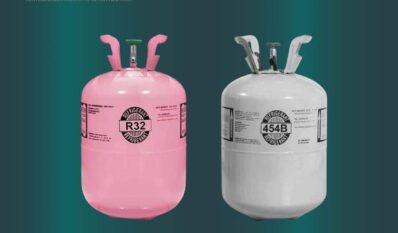
Flammability, Safety, and Precautions of Modern Refrigerants (R-32 & R-454B)
As new refrigerants replace older HFCs, many homeowners are surprised to learn that today’s alternatives — including R-32 and R-454B — are classified as A2L refrigerants, meaning mildly flammable. This does not mean dangerous, but it does mean HVAC systems must be engineered with modern safety features.
A2L refrigerants ignite only under very specific conditions, requiring high concentrations and an ignition source — scenarios unlikely in a properly installed system. Still, these refrigerants require:
-
Updated building codes to ensure safe installation
-
Specialized training for technicians
-
Sensors, shutoff controls, and proper airflow in system design
-
Approved storage and transport procedures
Manufacturers have redesigned equipment to fully mitigate risks, and when installed correctly, these systems are considered safe for residential and commercial buildings. The slight flammability classification exists because these refrigerants break down faster in the atmosphere, which reduces climate impact but introduces mild flammability — a trade-off modern engineering accounts for.
What Homeowners Will Notice — Cost, Repair, and Maintenance Impacts
Because fewer HFCs are being produced, supply shrinks, and prices rise. This means that repairing older HVAC systems using common refrigerants like R-410A often costs more than before. Also, older systems may become harder to service if supplies of refrigerant become limited (EPA, 2022; EPA, 2024).
Homeowners may ask: “Is my system now illegal?” or “Will I be forced to replace my HVAC?” The answer: no. Existing equipment remains legal, and you can still get service. But as supply tightens and costs increase, it sometimes becomes more practical — economically and environmentally — to consider replacing older systems with newer ones designed for modern refrigerants (EPA, 2021; NCSL, 2025).
Hidden Costs of Replacing Your HVAC System Under New Standards
Replacing your HVAC system during the refrigerant transition may involve expenses homeowners don’t always expect. Beyond the equipment cost itself, several “hidden” factors can influence the total project budget:
1. New Building Code Requirements
A2L refrigerants require updated building codes. Depending on local regulations, installation may call for:
-
Modified electrical components
-
Enhanced ventilation or clearance requirements
-
Approved line sets
-
A2L-rated safety devices
Technicians must meet new certification requirements, which can raise labor prices.
2. Larger System Footprints
Many R-454B and R-32 systems are designed with larger coils or cabinets to improve efficiency and reduce global warming potential. This can require:
-
Expanding the pad or platform for the outdoor unit
-
Modifying closet, attic, or garage HVAC spaces
-
Additional duct adjustments
These modifications often add material and labor costs.
3. Labor Costs During Transition Years
As contractors adapt to new standards, job times may increase due to:
-
Additional testing steps
-
Extra safety checks
-
Code-mandated documentation and commissioning
All of these factors contribute to higher installation prices compared to previous years.
What Comes Next — New Refrigerants and Updated HVAC Systems
The HVAC industry is shifting to refrigerants such as R-32 and R-454B. These have significantly lower global warming potential (GWP) than many older HFCs like R-410A. For example, R-454B offers a large reduction in GWP while maintaining similar thermodynamic performance (Grokipedia, 2025).
Because these new refrigerants behave differently (different pressures, slightly different cooling properties), HVAC systems have to be engineered or designed to match — you can’t just swap refrigerants in older systems without risking damage or failure.
Cost Differences: R-454B vs. R-32 for Maintenance
As the market transitions, maintenance costs will differ between R-454B and R-32 systems:
R-454B
-
Typically slightly more expensive to manufacture
-
Requires specific safety components
-
Replacement refrigerant cost may be higher
-
Designed as the direct “successor” to R-410A for many manufacturers
R-32
-
Often cheaper per pound
-
More efficient in many system designs
-
Used widely internationally, increasing long-term availability
-
Slightly higher flammability rating than R-454B, requiring updated system engineering
In practice, R-32 systems often have lower long-term maintenance costs, while R-454B systems may be more common in North America due to OEM preferences.
Time Restraints for Installing R‑410A Equipment
Under updated EPA allowances and regulations tied to the American Innovation and Manufacturing Act (AIM Act), the following key timing rules apply for HVAC systems using R-410A refrigerant:
-
January 1, 2025 — New residential and light‑commercial HVAC systems using R‑410A are no longer permitted for manufacture or import (Airflow, 2023).
-
2023–2024 — Manufacturers and suppliers were already reducing inventory and preparing for the transition by limiting new R‑410A‑charged unit production and sales (Airlogix, 2023).
-
January 1, 2026 — Deadline for installation of pre‑2025 manufactured split residential/light‑commercial systems under some regulatory proposals (ACCA, 2024).
-
2025 and after — Refrigerant supply for R‑410A becomes more restricted: bulk production and import allowance quotas shrink under the phasedown schedule (EPA, 2024).
What this means in practice:
-
Existing HVAC units running on R‑410A remain fully legal and may be serviced with reclaim or remaining supply refrigerant for now (Trane, 2023).
-
New installs using R‑410A must have been completed by end of 2025 — after that, new systems should use low‑GWP alternatives like R-32 or R-454B (MultifamilyNW, 2023).
-
Once inventory runs out, there will be no new R‑410A equipment — even if demand remains. Choosing to delay replacement means risking lack of availability, higher price, or forced use of newer refrigerant systems (EPA, 2024).
Given these dates, the window to knowingly install a brand-new R‑410A-equipped HVAC system is closing. For homeowners and contractors, planning ahead is key — whether that means securing inventory now or opting for next‑generation refrigerant systems for long-term compliance and cost stability.
What Homeowners Should Do Now
-
Check what refrigerant your system uses (look at the label on the outdoor unit).
-
If your system uses older HFCs and is more than 10–15 years old, start considering a replacement.
-
When buying new HVAC equipment, opt for models rated for the newer refrigerants (R-32, R-454B).
-
Maintain your system carefully to avoid leaks — refrigerant leaks are more costly now, and releasing HFCs undermines the environmental goals of the AIM Act (EPA, 2024).
The Bigger Picture — Climate, Efficiency, and Long-Term Savings
The phase-down under AIM is expected to reduce U.S. HFC emissions by billions of metric tons of CO₂-equivalent through 2050 (EPA, 2021). Over time, newer systems using lower-GWP refrigerants will also be more efficient, saving energy and lowering bills. So even though near-term repair or replacement costs might rise, long-term savings and environmental benefits are significant.
If you’re unsure which refrigerant path makes the most sense for your home—or you just want help understanding how the AIM Act impacts your current system—our team can walk you through the options, explain upcoming regulations, and make sure you’re prepared for the changes ahead. Feel free to reach out with questions or to schedule an evaluation.
Visit our service page here → Schedule Now
Key Takeaways
-
The AIM Act is phasing down high-GWP HFC refrigerants, including R-410A, which will affect pricing, inventory, and future HVAC system options.
-
New refrigerants like R-32 and R-454B are A2L (mildly flammable) but engineered with advanced safety features that make them safe when installed correctly.
-
R-410A equipment can no longer be manufactured after Jan. 1, 2025, and installation deadlines will phase out remaining inventory through 2025.
-
Homeowners may face hidden costs during replacement, including new building code requirements, larger equipment footprints, line-set upgrades, and increased labor.
-
R-32 and R-454B differ in cost, performance, and long-term maintenance, with R-32 often being more affordable but R-454B widely used by many North American OEMs.
-
Delaying replacement may limit equipment choices, especially as R-410A supply tightens and new systems become the standard.
-
New low-GWP systems offer long-term benefits, including improved efficiency, lower climate impact, and future-proof compliance with federal regulations.
Works Cited
ACCA. EPA Proposes Rollback of Refrigerant Rule: What It Means for HVACR Contractors. ACCA, 2024.
Airflow. “Important Changes Coming for Air Conditioning Refrigerants.” Airflow Designs, 2023.
Airlogix. “R-410A Phase-Out: A Property Manager’s Guide.” Airlogix, 2023.
EPA. American Innovation and Manufacturing Act (AIM Act) Overview. Environmental Protection Agency, 2021.
EPA. HFC Phasedown and Refrigerant Management Regulations. Environmental Protection Agency, 2022.
EPA. Future of Refrigerants and AIM Act Implementation. Environmental Protection Agency, 2024.
Grokipedia. “Low-GWP Refrigerants: R-32 and R-454B.” Grokipedia, 2025.
IIAR. Hydrofluorocarbon Impacts on Global Warming and Industry Transition. International Institute of Ammonia Refrigeration, 2024.
MultifamilyNW. “Major HVAC Refrigerant Changes Are Coming — Are You Ready?” MultifamilyNW, 2023.
NCSL. State Laws & Policies on Refrigerant Phaseouts. National Conference of State Legislatures, 2025.
Trane. “What Is R-410A Refrigerant?” Trane Residential Resources, 2023.
Senate EPW. Senate Committee on Environment and Public Works: HFC Reduction Legislation. Senate EPW, 2020.
FAQ
Do I have to replace my R-410A system?
No. Existing systems remain legal to own and repair. However, as refrigerant supply shrinks, repairs may become more expensive, making planned replacement more practical.
Are newer refrigerants like R-32 and R-454B safe for homes?
Yes. Although labeled “mildly flammable,” A2L refrigerants require conditions to ignite, such as u003cstrongu003ea large, concentrated leak combined with an open flame or strong spark in a confined spaceu003c/strongu003e. Modern HVAC systems are engineered with sensors, airflow controls, and safety components that make them safe for residential installation.
What makes these new refrigerants better for the environment?
What makes these new refrigerants better for the environment?
Why are replacement costs higher during the refrigerant transition?
Costs can increase due to updated building codes, new safety requirements, larger system footprints, labor adjustments, and limited availability of older equipment.
Which refrigerant is cheaper to maintain — R-32 or R-454B?
In many cases, R-32 tends to be u003cstrongu003echeaper per poundu003c/strongu003e and widely used internationally, which may reduce long-term costs. R-454B equipment is often OEM-driven and slightly more expensive to service, but still a strong low-GWP option.
How long do I have to install a new R-410A system?
Manufacturers stopped producing new R-410A equipment on u003cstrongu003eJan. 1, 2025u003c/strongu003e. Most remaining inventory must be installed by the end of u003cstrongu003e2025u003c/strongu003e. After that, only systems using modern refrigerants will be available.
Can I simply “switch” my current system to a new refrigerant?
No. R-32 and R-454B operate at different pressures and require different engineering. Retrofitting older systems is unsafe and not recommended.
Will new refrigerants lower my utility bills?
Yes — most new low-GWP systems are designed with improved coils, efficiency ratings, and compressor technologies that reduce energy consumption.
Is one refrigerant clearly better than the other?
Not necessarily. R-32 tends to be more cost-efficient and widely adopted internationally. R-454B is designed to closely replace R-410A and align with many U.S. manufacturers’ product lines. The best choice depends on system type, home design, and availability.
How do I know which refrigerant my system uses?
Check the outdoor unit’s label — it will clearly list the refrigerant type (R-410A, R-32, R-454B, etc.). Your technician can also confirm it during a service visit.