November 21, 2025
By Varitek Heating & Air Conditioning Team
Most homeowners believe that all furnaces heat equally, but that’s not true. The way a furnace functions significantly affects comfort, noise levels, efficiency, temperature stability, and air quality. These differences mainly depend on staging, which describes how many heating levels a furnace can provide. Think of a furnace as a car that can have one speed, two speeds, or a full throttle option. This analogy highlights why the type of furnace is more important than its brand. Single-stage systems operate at full capacity and then shut off (PickHVAC, 2025). Two-stage systems offer two levels of heating (Pick-Comfort, 2025). Modulating systems can make tiny adjustments for precise temperature control (Lennox, 2025).
Single-Stage Furnaces
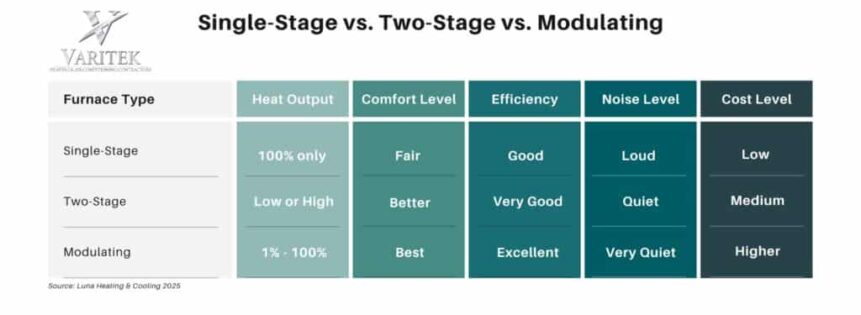
A single-stage furnace functions similarly to a car with only two modes: completely off or at full throttle. It delivers a single heat output at 100% capacity. When the thermostat calls for heat, the furnace switches on at maximum power, quickly warming the home, then turns off completely, repeating this cycle throughout the day (PickHVAC, 2025). Homeowners often notice temperature fluctuations between warm and cool, along with louder startup and shutdown sounds and increased energy consumption (Luna, 2025). The primary benefit of a single-stage furnace is its lower initial cost, making it a popular choice for small homes, simple duct systems, rentals, or budget-conscious upgrades (Poormans, 2021).
Two-Stage Furnaces
A two-stage furnace functions similarly to a car with two gears: low and high. In stage one, it operates at about 60 to 70 percent capacity, while in stage two, it runs at full 100 percent output (Pick-Comfort, 2025). Usually, the furnace stays in stage one, running longer at a quieter, lower heat setting, and switches to stage two during colder weather or high heating needs (Pick-Comfort, 2025). Homeowners often experience more even temperatures, less noise, smoother airflow, and lower energy consumption compared to single-stage models (Luna, 2025). Two-stage systems also enhance indoor air quality by circulating air more consistently and avoiding the rapid on-off cycles typical of single-stage systems (Poormans, 2021). A Department of Energy study indicates that two-stage furnaces with variable or multi-speed motors can reduce electricity use relative to single-stage models (DOE, 2006). This type of furnace is an effective choice for medium-sized homes and families seeking improved comfort without investing in a fully modulating system.
Modulating Furnaces (Variable-Capacity)
A modulating furnace, also known as a variable-capacity furnace, operates similarly to a car with an intelligent gas pedal that smoothly adjusts speed instead of switching between a few fixed levels. It can finely tune heat output in small steps, often as little as one percent, and rarely needs to run at full capacity (Lennox, 2025). This precise control helps keep the temperature within about half a degree of the thermostat setting (Pick-Comfort, 2025). Homeowners enjoy maximum comfort with no noticeable temperature fluctuations. These systems are the quietest, most efficient, and excel at providing steady, controlled airflow (Pick-Comfort 2025). Because they operate longer at lower outputs, they also offer consistent air filtration, enhancing indoor air quality (Poormans, 2021). They are ideal for homes with hot and cold spots, for individuals sensitive to noise or temperature swings, for long-term residents, and for those upgrading from older floor or wall furnaces who seek significant comfort improvements (Lennox, 2025).
Why This Matters for LA & SoCal Homeowners
This breakdown is particularly important for homeowners in Los Angeles and Southern California. Due to the region’s mild climate, furnaces rarely operate at full capacity. Two-stage and modulating furnaces usually run in low mode during most of the season, offering significant comfort and energy efficiency benefits without greatly increasing gas use. Homes with older ductwork, which are common in LA, often face uneven airflow. Modulating systems can significantly enhance comfort by providing more consistent and gentle heating across the home.
Quick Comparison Chart
Which System Is Right for You?
Selecting the appropriate system depends on the home’s needs and the homeowner’s priorities. A single-stage furnace is suitable for those prioritizing cost over comfort. A two-stage furnace provides improved comfort and airflow at a lower cost than a fully variable system. A modulating furnace delivers the maximum comfort, quietness, air quality, and energy efficiency, making it ideal for older or uneven homes that need stable, controlled heating.
Ready to upgrade your home’s comfort?
Explore your options or schedule a professional furnace evaluation with us today. Visit our service page here → Schedule Now
DOE. Residential Two-stage Gas Furnaces. U.S. Department of Energy, 2006.
Lennox. “What Is a Modulating Furnace?” Lennox, 2025, www.lennox.com
Luna Heating & Cooling. “Single-Stage vs Two-Stage vs Modulating Stage Furnace.” Luna Heating & Cooling, 2025, www.lunaheatingcooling.com.
PickHVAC. “The Difference Between One-Stage and Two-Stage Furnaces.” PickHVAC, 2025, www.pickhvac.com.
Pick-Comfort. “Modulating vs Two-Stage Furnace.” Pick-Comfort, 2025, www.pick-comfort.com
Poormans Heating & Air. “One Stage, Two Stage and Modulating Furnaces.” Poormans Heating & Air, 2021, www.poormansheatingair.com
Key Takeaways
-
-
Furnace “staging” determines how many heating levels your system can operate at.
-
Single-stage furnaces are budget-friendly but create noticeable hot-and-cold cycles.
-
Two-stage furnaces offer quieter, smoother, more efficient heating for most homes.
-
Modulating furnaces provide the highest comfort, best temperature consistency, and top efficiency.
-
Homes with uneven heating benefit the most from modulating or two-stage systems.
-
Longer, lower-speed operation helps improve indoor air quality and airflow balance.
-
Choosing the right furnace depends on your home layout, comfort preferences, and long-term budget goals.
-
FAQ
What does “staging” mean in a furnace?
Staging refers to how many levels of heat output a furnace can produce. A single-stage furnace has one speed, a two-stage furnace has two heating levels, and a modulating furnace can adjust in very small increments for precise comfort.
Why does staging matter for comfort?
The more heating levels a furnace has, the more smoothly it can warm your home. Two-stage and modulating furnaces reduce temperature swings, minimize noise, and create more consistent airflow.
Does a modulating furnace really save more energy?
Yes. Because it rarely runs at full power and can adjust output precisely, a modulating furnace avoids energy waste from constant on/off cycling.
Are two-stage furnaces worth the upgrade from single-stage?
For most homeowners, yes. They offer better comfort, quieter operation, and improved efficiency without the higher price of a modulating system.
What type of furnace is best for homes with hot and cold spots?
A modulating furnace performs best in homes with uneven temperatures because it constantly adjusts airflow and heat output to maintain balance.
Is a modulating furnace too advanced for older homes?
Not at all. Homes with older ductwork often see the biggest comfort improvement because the furnace can run at lower, steadier speeds instead of blasting air all at once.
Do staging levels affect indoor air quality?
Yes. Furnaces that run longer at lower speeds move more air through the filter, improving overall air cleanliness and reducing dust.